01 · Pause first
You can pause before you make a plan.
Start with any section. Follow the order, move around or choose only one prompt. You can skip anything that does not fit today. When you are ready, build and save your remedy card. It will stay in this browser so you can revisit it later.
Stress can make every task look urgent. Your mind may jump between the past, the next hour and the worst possible ending. Begin with a smaller time frame. What would help during the next ten minutes?
“A lot is happening. I can meet this moment before I meet the whole problem.”
This page is a reflection tool. It is not a test or diagnosis. Take the parts that feel useful. Leave the rest for another day.
02 · Find yourself on the tree
Sometimes a picture finds the feeling first.
Look at the numbered Blob Tree in the source article. Choose the number that feels closest to you right now. Notice what drew you to that figure. There is no correct choice. Use the picture as a prompt, rather than a diagnosis.
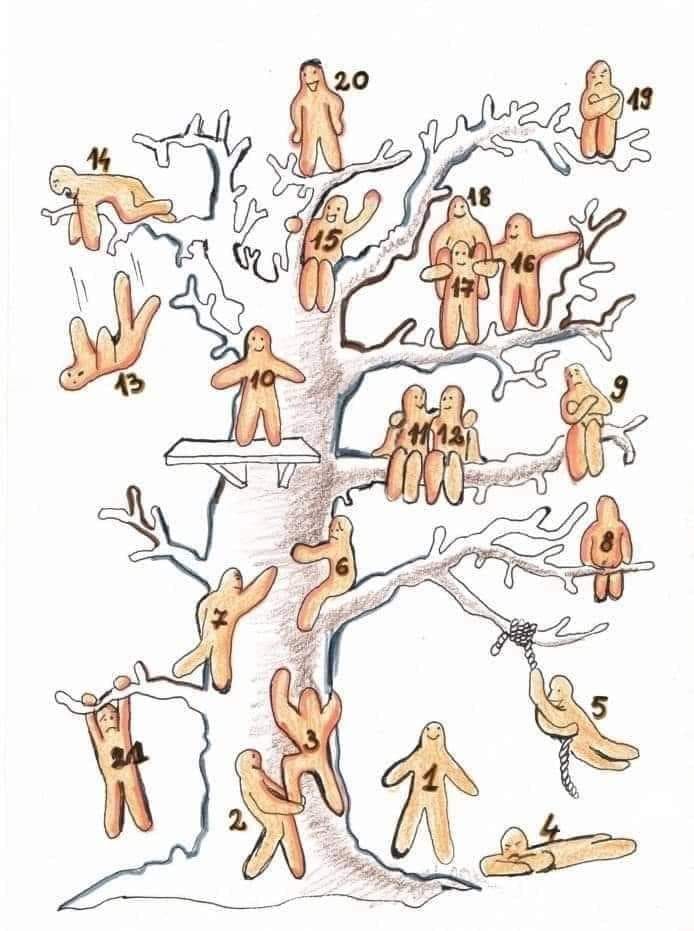
Image source: “Which Blob Person Are You?” by Raluca Barna, The Summit on Medium. The article credits the image to BlobTree.com. Blob Tree was created by Pip Wilson and Ian Long.
03 · Remember your evidence
You have met difficult days before.
Think of the last time you felt this stressed. Look for anything that helped by five percent. It may have been small. A shower counted. A sandwich counted. A message to a friend counted. Going to bed early counted.
Your answer is personal evidence. It gives you a better starting point than a list written for everybody.
04 · Look at the worry
Put the feared ending where you can see it.
A worry often grows when it stays vague. Write the outcome you fear most. Use plain words. Then look at it with curiosity. You are observing a thought. You are not making it happen by writing it down.
05 · Act, ask, wait or release
Choose the kind of response.
Some worries need action. Some need another person. Some need time. Some ask you to carry responsibility that was never yours. Choose the closest response for today.
Releasing a worry does not mean approving it. It does not require certainty. It can mean, “I have given this enough attention for now. I will return at 3 pm.”
06 · Help the body
Choose a small signal of safety.
Reasoning can feel easier after the body receives care. Pick one or two ideas. The useful choice is the one you can actually do now.
Add something that works for you
07 · Your personal remedy
Build a card for this moment.
Your card gathers the parts you chose. It does not need to fix everything. It only needs to make the next part of the day kinder and more possible.
Anything you save in sections 02–06 can appear here. You can build a card from one saved section or several of them.
For this moment
My stress remedy
Saved in this browser
Your remedy history.
Your saved cards stay on this device and in this browser.
Your saved stress remedies will appear here.
When more support would help
You deserve support before things become unbearable.
If stress keeps returning, changes daily life or feels hard to carry alone, consider speaking with someone you trust, your GP, a counsellor or your university support service.
In England, use NHS 111 online or call 111 and select the mental health option for urgent mental health help. If you or someone else is in danger, call 999 or go to A&E.